
Liftgate Service for Warehouse Deliveries: When You Need It
What liftgate service is, when a warehouse delivery requires one, how the gate handles heavy pallets, and why it matters for freight moving through the Kent Valley and the Port of Seattle and Tacoma.
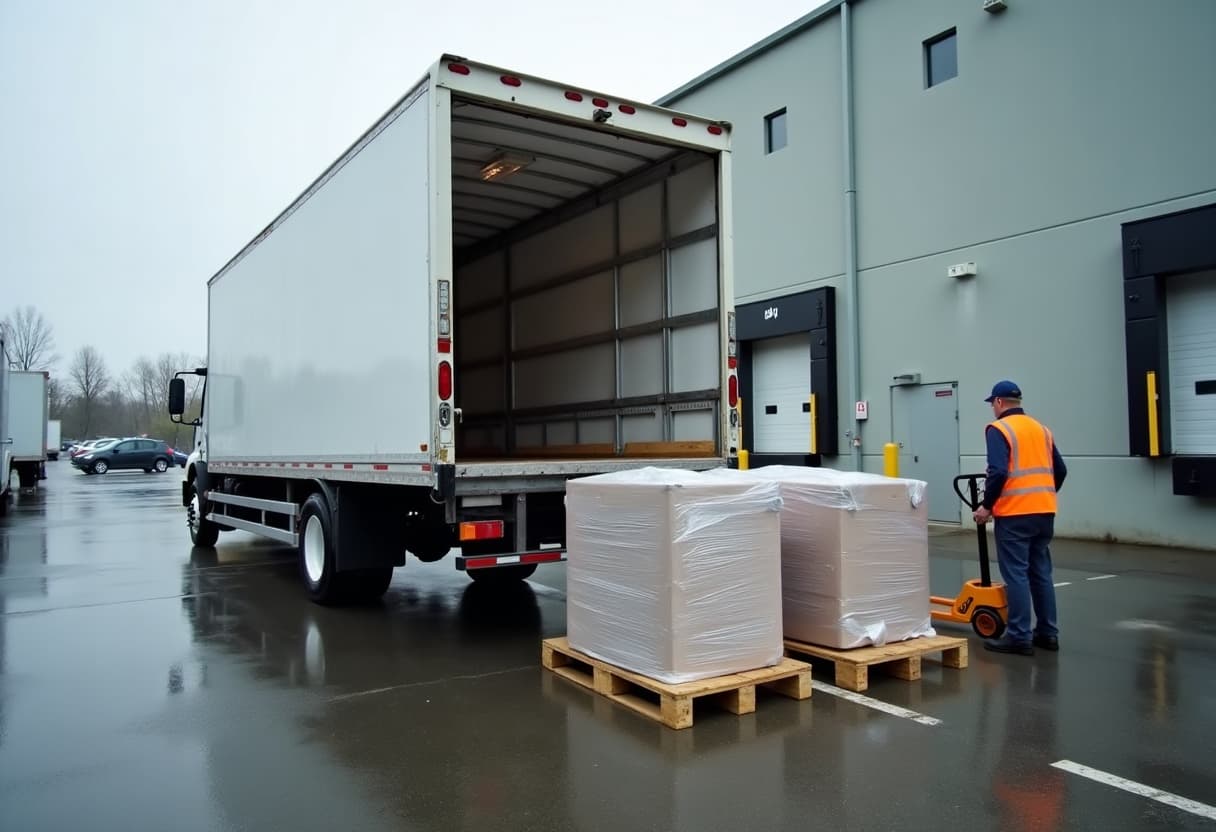
If you ship freight to a warehouse, a distribution center, or a business that does not have a loading dock, liftgate service is what makes the delivery possible. The gate is the hydraulic platform on the back of the truck that lowers pallets to the ground. Without it, a driver arriving at a dockless location has no safe way to get heavy freight off the trailer. This post covers what liftgate service is, when you need it for a warehouse delivery, how it works, and why it matters for freight moving through the Kent Valley.
What liftgate service is
A liftgate is a metal platform fitted to the rear of a box trailer or straight truck. It runs on a hydraulic pump powered by the truck's electrical system. The driver rolls the pallet onto the platform using a pallet jack, releases the gate from the locked position, and lowers the load to ground level. At the destination the process runs in reverse for loading.
The gate does the work a dock would normally do. It bridges the height gap between the trailer bed, which sits roughly 48 inches off the ground, and the pavement. That height gap is the whole problem. A pallet of freight weighing 1,500 pounds cannot be lifted down by hand, and a forklift is not always waiting at the other end.
Liftgate service is the carrier add-on that puts a gate-equipped truck on your shipment. Most LTL carriers offer it as an accessorials charge, and most full-truckload brokers can source a liftgate trailer when the delivery requires one. The charge is small compared to the cost of a failed delivery where the truck shows up and cannot unload.
When you need liftgate service for a warehouse delivery
Not every warehouse delivery needs a gate. The deciding factor is what is at the receiving end. You need liftgate service when any of the following is true.
The receiving location has no loading dock. This is the most common scenario. A retail backroom, a small business, a job site, or a warehouse annex without dock-high doors has no way to receive a trailer-load of freight at trailer height. The gate gets the pallets to the ground so they can be rolled inside.
The dock is the wrong height or configuration. Some older buildings have docks built for straight trucks, not 53-foot trailers. A gate lets the driver unload to the ground and move freight in through a ground-level door.
The freight is too heavy for a hand unload. Even at a docked location, if the pallet weight exceeds what a driver can move with a manual pallet jack on a grade, the gate provides a controlled descent. This matters for dense cargo like bottled liquids, metal stock, or machinery.
It is a partial unload. A truck making multiple stops may have a dock at the first drop and no dock at the second. The gate handles the second stop without rerouting the freight.
If you are unsure, the rule of thumb is to request the gate. The add-on cost is lower than a re-delivery fee, and most carriers cannot source a gate-equipped truck on the same day once a driver is already en route.
How liftgate service works with warehouse receiving
When freight with a liftgate delivery arrives at a warehouse like ours, the handoff is straightforward. The driver lowers each pallet to the ground on the gate. Our receiving crew takes the pallets from there, scans them into our inventory system, and moves them to their assigned storage location.
The gate is one piece of the delivery, but it changes what we can receive. Pallets that arrive at ground level can be staged outside the dock door and brought in through a ground-level bay, which matters when the dock doors are occupied with other trailers. It also lets us receive from carriers that do not run dock-height trailers, which broadens the pool of trucks we can take freight from.
For outbound shipments, the same logic applies in reverse. If your customer does not have a dock, we load pallets onto a gate-equipped trailer and the driver lowers them at the destination. We coordinate the carrier, the gate, and the delivery appointment so the freight moves without a gap.
Why liftgate service matters in the Kent Valley
The Kent Valley runs between the Port of Seattle and the Port of Tacoma, with I-5 and SR-167 cutting through it. That geography makes it the primary warehousing corridor for the Pacific Northwest, and it also makes it a region where liftgate service comes up constantly.
A lot of the freight that moves through Kent is drayage from the ports. Containers come in, get transloaded at a warehouse like ours, and then move out on domestic trailers for regional delivery. Many of those delivery points are small businesses, retail locations, and commercial sites that do not have loading docks. A shipment that starts at our dock in Kent and ends at a store front in Seattle or Tacoma often needs a gate at the final stop.
The same is true for freight moving the other direction. A supplier in Sumner or Auburn may not have dock-height doors but still needs to ship pallets into the Kent Valley for consolidation. A liftgate truck picks up at their location and the freight arrives at our facility ready to receive.
This is one reason we coordinate liftgate service as part of our warehousing and distribution operation. The delivery does not end when the freight leaves our dock. It ends when the pallet is on the ground at the right address, and at many of those addresses a gate is the only way that happens.
Liftgate service versus dock-high receiving
It helps to know the difference when you are scheduling a delivery.
A dock-high trailer backs up to a dock door, the dock leveler bridges the gap, and freight rolls straight off the trailer onto the dock floor. This is the fastest way to move pallets, and it is what every warehouse with dock doors is built for. No gate is involved.
A liftgate trailer has no dock to back into. The driver unloads to the ground, one pallet at a time, using the hydraulic platform. It is slower than a dock unload, but it works anywhere.
Most warehouse-to-warehouse freight moves dock-high. Most warehouse-to-business or warehouse-to-retail freight needs a gate. If you are not sure which your shipment needs, the person receiving the freight can tell you whether they have a dock. If they do not, book the gate.
What it costs
Liftgate service is typically billed as an accessorials on the freight invoice. Rates vary by carrier, but the charge is usually in the range of $25 to $95 per delivery, depending on the carrier and the lane. Some carriers bundle it into a residential delivery fee if the destination is a residence.
The cost is a small fraction of the total freight bill, and it is almost always cheaper than the alternative. A delivery attempted without a gate that cannot be completed turns into a re-delivery, which adds a second accessorials charge, a second driver dispatch, and a delay that can push a delivery past its appointment window.
When we coordinate liftgate service for freight moving out of our facility, we book the gate up front based on the destination. If the receiving location has no dock, the truck has a gate. The charge shows up as a line item on the handling invoice, not buried in a bundled rate.
Common mistakes to avoid
Assuming the receiving location has a dock. This is the mistake that causes most failed liftgate deliveries. Confirm with the receiver before booking the truck. If they are not sure, book the gate.
Underestimating pallet weight. A standard gate handles 2,000 to 3,500 pounds per lift. If a pallet is over that, the gate will not move it. Dense cargo like liquid totes or metal stock can exceed the rating, and that freight needs a forklift at the destination or a dock-high trailer.
Booking the gate after dispatch. Once a truck is assigned and en route, adding a gate is not always possible. The gate has to be on the truck that shows up. Request it when you book the shipment, not the day before delivery.
Forgetting the delivery appointment. A liftgate delivery takes longer than a dock drop because each pallet comes down individually. The receiving location needs someone present to accept the freight and sign for it. A gate delivery is not a drop-and-hook.
Getting it set up
If you have freight moving through the Kent Valley and the delivery point does not have a dock, we can coordinate the liftgate as part of the shipment. Our facility handles drayage from the Port of Seattle and Port of Tacoma, transloading and cross-dock work, and regional distribution along the I-5 corridor. We book the right truck for the destination, whether that means dock-high or gate-equipped.
For more on how freight moves through this region, our posts on the Kent Valley logistics hub and trucking warehouse services cover the infrastructure side in more detail.
Contact All Season Warehouse or call (253) 246-2125 with your shipment details, and we will tell you whether your delivery needs a gate and get the right truck on it.
Frequently asked questions
What is liftgate service?+
Liftgate service is a freight delivery option where the truck is equipped with a hydraulic lift mounted at the rear of the trailer. The liftgate raises and lowers pallets, crates, and heavy items between the trailer bed and the ground, so freight can be unloaded at locations that do not have a loading dock. It is used for residential deliveries, commercial sites without dock-high doors, and any shipment too heavy for a driver to hand-unload.
When do I need liftgate service for a warehouse delivery?+
You need liftgate service when the receiving location has no loading dock, the dock is the wrong height for the trailer, or the freight is too heavy to be manually unloaded. Warehouses in the Kent Valley that receive from carriers without appointment docks often require a liftgate to get pallets to the ground safely. It is also used for partial unloads where only a few pallets come off at a stop.
How much weight can a liftgate handle?+
Most standard truck liftgates are rated for 2,000 to 3,500 pounds per use. Some heavy-duty gates handle up to 5,000 pounds. The limit applies per lift, not per shipment, so a 10-pallet load can move through the gate one pallet at a time. Freight that exceeds the gate rating needs a forklift at the destination or a dock-high trailer.
Does All Season Warehouse offer liftgate service in the Kent Valley?+
All Season Warehouse coordinates liftgate deliveries for freight moving in and out of our Kent facility, including drayage from the Port of Seattle and Port of Tacoma and regional distribution runs along I-5 and SR-167. If your shipment is headed to a location without a dock, we can arrange a liftgate truck and handle the pallet-level receiving on our end.